Saturday, 18 October 2014

Srinagar City Tour - Part 1

A one day Srinagar city tour is indeed the best way to experience the pulse, beauty and its ever changing frames. Just like a there are two sides to a coin, the new Srinagar is the commercial beauty and old Srinagar is filled with the richness of the Mughal empire history and ancient architecture. I would strongly advise you to start the city tour by 8 am to avoid traffic.


The Quieter Side of Dal Lake
 

Shankaracharya Temple

The ancient Sankaracharya Temple, also known as the Jyesteswara Temple, is found on top of the hill Takht-i-Sulaiman or Throne of Solomon, at the height of 350m. Overlooking the lake, Adi Shankaracharya (788-820AC) lived, meditated and did Tapas (penance) here to review Hinduism which had been eclipsed by Buddhism.

To read more, click on http://www.mukti4u2.dk/Srinagar_Shankaracharya_Temple.htm
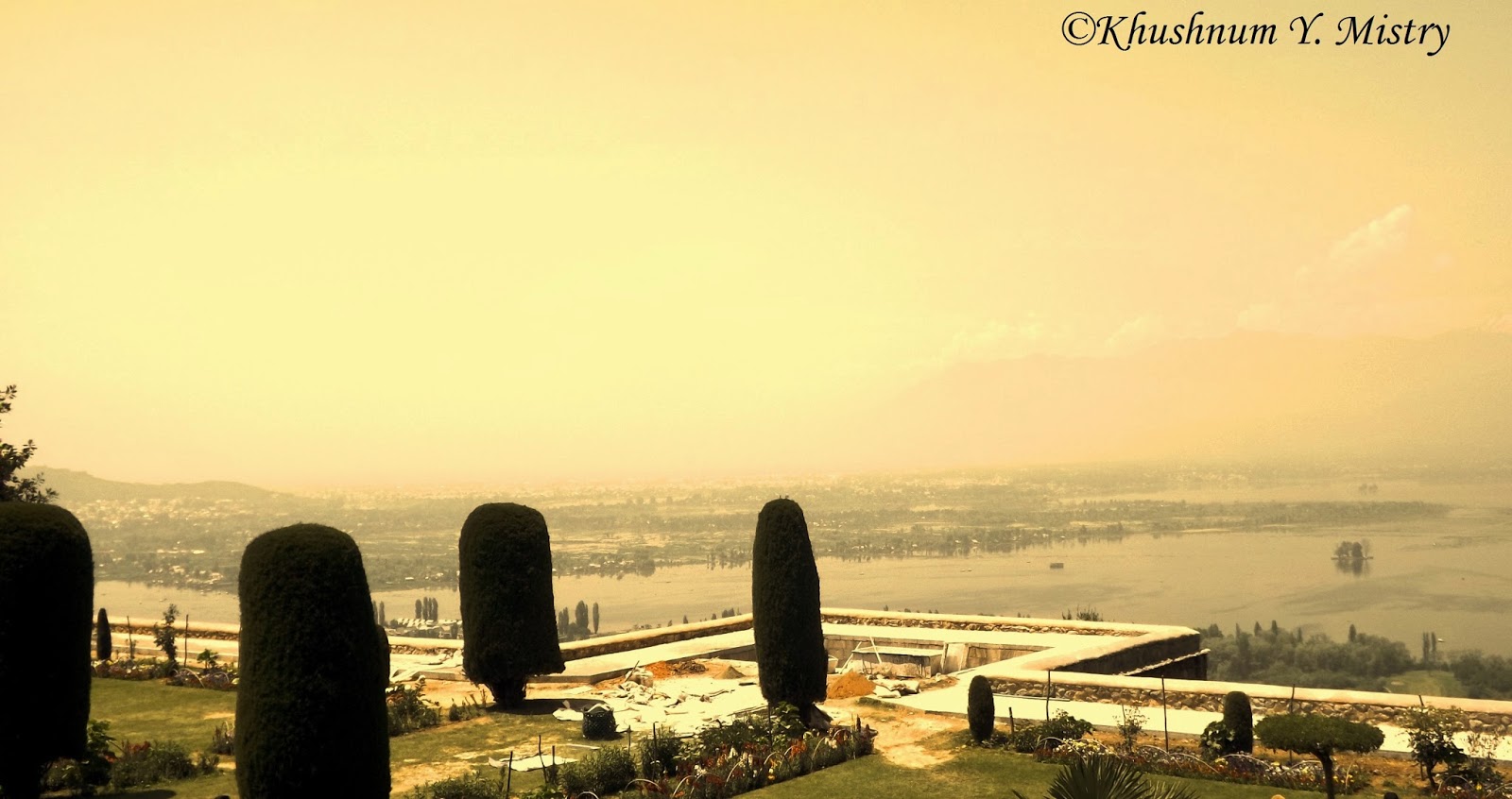
City View from Shankaracharya Temple
The car takes you only up to a certain point, after which you need to climb 40 stairs to enter the temple premises. 
 
This image is taken from postcards and copied from
http://www.mukti4u2.dk/Srinagar_Shankaracharya_Temple.htm

The temple is completely built of stone, and as the sun’s ray hit, it shines like granite. A huge Shivling (a black stone considered to be a Hindu deity) with a huge bronze snake encircling it is grounded in the middle of this temple. At a time, this temple can only occupy 6 people and a pujari (priest).
During the olden times, this place would be the best place to meditate, pray or simply enjoy the beauty of the city. Photography is not allowed here, so leave your cameras and cell phones in the car or else you will need to deposit them outside the temple!

Distance: 20 minutes from Dal Lake, Gate No. 1
Entry Fee: Free


Chasme Shahi

Chasme Shahi

Chasme’ in Kashmiri means ‘water’ and ‘Shahi’ means ‘royal’ which is a great way of describing one of the oldest hot water spring found in Srinagar. On entering the Chasme Shahi, you are welcomed to a beautiful lawn with colourful flowers.


Fountains and Gardens in Chasme Shahi
In the centre of this garden, is a small stone funnel from where the hot water springs flow. Hot water springs are rich in chlorides that cure ailments like rheumatism, post and pre-operative surgeries and problems with the central nervous system. 
The Royal Water Tomb
Hot Water Spring

Chasmr Shahi
Distance: 20 minutes from Chasme Shahi
Entry fee: Rs. 10/-

Botanical Garden


Although, the botanical garden is beautiful with lots of flowers and custom shaped trees, it can be given a miss!

Distance: 5 minutes from Chasme Shahi
Entry Fee: Rs. 10/-


Pari Mahal 


Most tourists call it Pari Mahal, whereas the locals call it ‘Peer Mahal’. This palace could definitely be passed off as a residing abode for fairies.


The gardens were established by Prince Dara Shikoh in the mid-1600s on the ruins of a Buddhist monastery. Dara, the son of Emperor Shah Jahan, followed the Qadiri order of Sufi Islam and made the garden for his tutor. It was further used as an observatory, useful for teaching astrology and astronomy.


There are six ascending terraces at Pari Mahal, which display unique architectural elements of the mid-seventeenth century. 


Distance: 20 minutes from the Botanical Gardens

Entry fee: Rs. 10/-

Nishat Bagh

Nishat Bagh is a very average garden for the kids to play and can be definitely skipped. 

Shalimar Bagh 


Shalimar Bagh is considered to be the finest Mughal-style hill garden and was made by the Mughal Emperor Jahangir in 1619 for his beloved wife, Nurjahan. The Shalimar Bagh was built not merely as garden but also served as the summer residence of the Mughals.

The water canals and fountains are lined up parallel bordered with beautiful scented flowers and old architecture transports you to the Mughal era.  


There are four main areas or shamianas or terraces, the lower one is connected to the road. The second is considered to be the public garden also called as the Hall of the Public Audience. This area still has a small black marble throne.

The Second Area also called Hall of the Public

Black Marble Stone
The third area is wider with two shallow terraces with the Hall of Private Audience.

View from the Hall of the Private Audience


The fourth terrace area is the Zenana Garden that was reserved for the royal ladies of the court with small guard-rooms on the entrance. This part of the garden is definitely the most beautiful.


The Shalimar Bagh forms an ideal picture perfect sight; the water dancing, the flowers adding vibrancy to the already  cheerful atmosphere and your mind just soaking it all in!


Distance: 20 minutes from the Botanical Gardens
Entry fee: Rs. 15/-

Continue to Srinagar City Tour - Part 2...


Sunday, 12 October 2014

Kashmiri Wazwan - What and Where to Eat in Kashmir!

The history of modern Kashmiri cuisine can be traced back to the fifteenth century invasion of India by  Timur, and the migration of 1700 skilled woodcarvers, weavers, architects, calligraphers and cooks from Samarkand to the valley of Kashmir. The descendants of these cooks, the Wazas, are the master chefs of Kashmir. The ultimate formal banquet in Kashmir is the royal Wazwan.

Artwork at a Restaurant in Kashmir
Kashmiris are heavy meat eaters and it is still the most notable ingredient in their cuisine. The quality of the local produce and layers of flavour (in any of gravy that you order) send your senses to a trip to heaven and back. The mutton in Kashmir is by far, the most succulent (and the best) I have ever had in India.

On the Shikara, Dal Lake:

Steaming Gushtaba on the Shikara
I would advise you to eat the gushtaba (soft meat balls served with soup) from a shikara. Do not forget to ask for all the three chutneys:

  • The cucumber, red chilli powder and carrots
  • Carrots and cucumber mixed in curd with some spice
  • Chopped tomatoes mixed with some sauce, dahi and Kashmiri chilli powder
Chutneys Served with Gushtaba

Price: Rs. 150-200 (4 pieces)


Masal, Dal Lake Promenade:

On the Dal lake promenade, you will find a small temporary stall selling masal. It is ideally a Kashmiri version of bhel. A mix of chilli powder, sauced and chopped tomatoes are spread on a maida roti. They make a mixture of curd, carrot, cucumber and chickpeas and roll it into a wrap. It is simply a lip smacking healthy snack.

 Price: Rs. 40/- (for one wrap)
 

Shamyana (Dal Lake Promenade, Opposite Gate No. 2):

This is the best food joint in Srinagar. I would recommend any dish with mutton, mutton biryani, chicken biryani or the Kashmiri Wazwan (a Kashmiri food platter).
Price: Rs. 500 (for 2 people)


Sunset Boulevard (On the way to Shalimar Bagh):

This restaurant offers to you a wide variety of cuisine but I would only recommend eating Kashmiri food here. I recommend Rista, Rogan Josh and Dahiwal Korma along with a butter paratha for some dough with the gravy. Do not try the Momos!
Price: Rs. 600/- (for 2 people)


Lhasa (Dal Lake Promenade, Opposite Gate No. 9):

Lhasa Garden Restaurant
This restaurant serves lip smacking food. I would recommend you to sit in the garden area (the setting is made absolutely beautiful with a centre piece fountain). I recommend Rista, Chowmein and Rogan Josh.
Don’t order too much, as they are quite generous with their quantity.
Price: Rs. 400/- (for 2 people)

Mughal Darbar (Shervani Road)- Not Recommended

The Interiors of Mughal Darbar
 
 
This restaurant is the most recommended on all the ‘good food in Kashmir’ sites but it was a rather disappointing experience.
The Kashmiri Wazwan (its most recommended dish) was served cold. The food had a lot of oil. The meat was chewy and rubbery and the chicken served was raw. They did not have good sense of replacing the dish or even accepting the fact that it was raw in the first place.
The dishes are also highly priced compared to other restaurants.
Price: Rs. 650/- (for 2 people)


A Crash Course in Kashmiri Food (for non-vegetarians)

Kashmiri Wazwan
·        Rogan Josh: Red masala gravy with a smoky flavor with mutton/chicken

·        Dahiwal Korma: Curd cooked in masala with mutton/chicken


Kahwa
·        Rista: Minced mutton balls with red masala gravy (spicy)

·       Gushtaba: Soft meat balls served in gravy or boiled (similar to Rista but not spicy)

·       Kashmiri Wazwan: A platter of all the Kashmiri dishes

·       Tabak Maz: Fried goat ribs (not recommended, unless you like eating crispy fat)

·       Kahwa: A refreshing Kashmiri drink that includes namkeen tea, cinnamon and cardamom


Thursday, 9 October 2014

Row the Shikara, Gently Down the Lake

      Srinagar's Dal Lake is an ethereal beauty that will never pass into nothingness.


As one approaches the Dal Lake, there are hundreds of colourful houseboats lined up like ducks in a row beckoning to tourists.
Houseboats in Dal Lake

A Carved Wooden Balcony of a Houseboat
Dal Lake is the most commercial tourist destination in Srinagar, but it promises you an unforgettable experience (trust me on this).The beauty of this lake is mesmerizing; it is surrounded by the white majestic mountains (Pir Panjal) on one side, and historic milestones like the Mughal Fort and the Shankaracharya Temple on the other.  

Pir Panjal Mountains overlooking Dal Lake
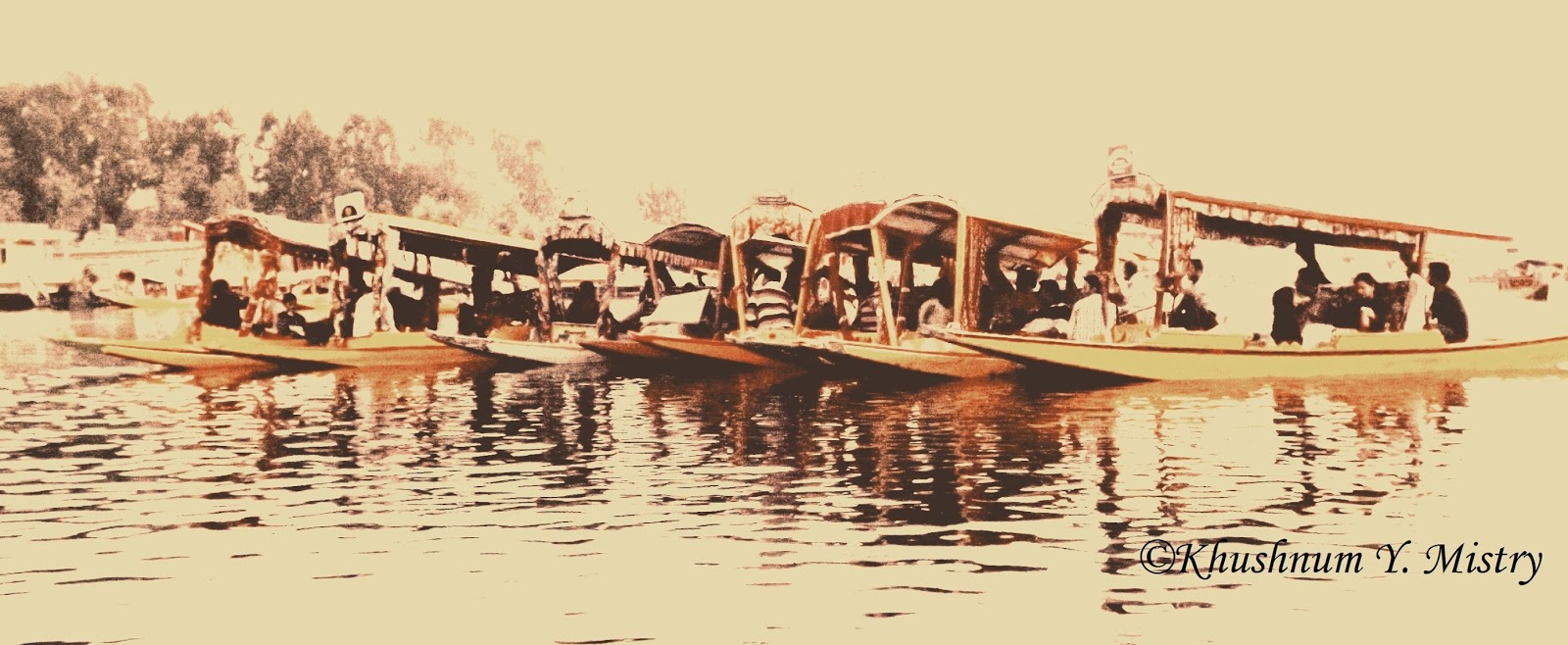
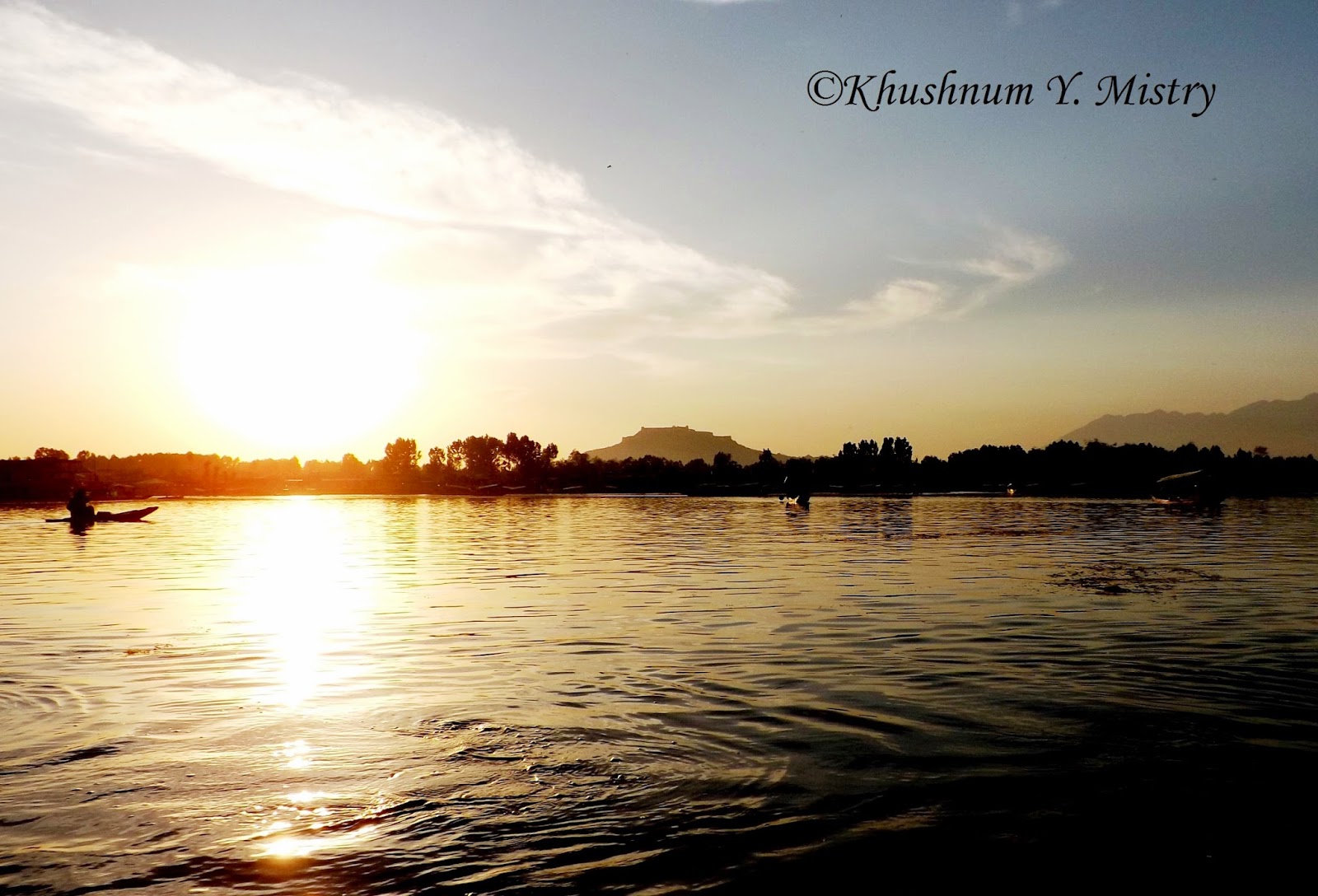
The Dal Lake is stretched along 15.5 kms. with a number of gates. These gates are shikara stops that help you reach the houseboat of your choice. The best way to enjoy the beauty of this place is to go for a sunset ‘cruise’ in the shikara.


The one hour shikara sunset tour covers the floating vegetable market, vegetable farms, Meena Bazaar and the Golden Lake.
Vegetable Farms in Dal Lake
 

Meena Bazaar

Dal Lake could also be called a floating ‘shopping mall’. You have your grocery vendor, a professional photographer trying to convince you to wear the Kashmiri dress and click pictures, jewellery dealers trying to sell you stones and artificial jewellery, and boatsmen selling the best (the very best) gushtabas (soft meat balls), sheikh kababs and kahwa (a refreshing and tasty Kashmiri drink)!

Boatman selling Kashmiri Food in the Lake
Don’t be surprised if the shikara boatman introduces you to the Golden lake while take a tour of the Dal Lake. As per a local Kashmiri, many years ago (during the Mughal times) anyone who looked down from the Shankaracharya temple (the temple overlooks the Golden lake) could see a bed of gold in that area of the lake. Many tried to get the gold but always ended up drowning or getting strangled by the water weed.  (Believe it or not!)

Golden Lake
As the sun sets, this lake pristine beauty comes to the fore as it sheds its commercial stance and reveals its true self. 

In the night, the houseboats light up like glow worms that reflect in the mirror-sheet of pristine water. My mind was lost in the antithesis of the moment; the bustling traffic of the tourists and the serenity of the lake.
Free Tips:
·       Don’t forget to bargain with the shikara boatmen, they will probably always charge you more than you need to pay.  
·       If you are an early riser you can visit the vegetable market (from 5 am to 7 am) in the shikara to get some of the best local produces like vegetables, fruits and spices.
·        Ask your houseboat owner to assign you a shikara or a small boat to pick you up from the gates.
·        Shopping in Dal Lake is more expensive than shopping from the promenade roadside shops or shops in Srinagar.
·       Kashmiri people love talking and are warm, friendly people who love to help. Don't mistake them to be inquisitive (although please do not indulge a personal or intense conversation).
Cost: Rs. 400/- to Rs. 600 for one hour in the shikara. The cost of the trip to the vegetable market early morning is around the same.